
Satellite telemetry reveals spatial overlap between vessel high-traffic areas and humpback whales (Megaptera novaeanglia) near the mouth of the Chesapeake Bay.
Frontiers in Marine Science. 2025.
7:121
More details
Collapse details
Date Published:
Publication:Ocean:Region:Species:Methods:
- March 11, 2025
From December 2015 to February 2017, 35 satellite tags were deployed on humpback whales to gain a better understanding on the occurrence, movements, site-fidelity, and overall behavior of this species within this high-traffic region.
Habitat-Based Density Models for Three Cetacean Species off Southern California Illustrate Pronounced Seasonal Differences.
Frontiers in Marine Science. 2017.
4:121. doi: 10.3389/fmars.2017.00121.
More details
Collapse details
Date Published:
Publication:Ocean:Region:Species:Methods:
- May 10, 2017
The objectives of our study were two-fold: (1) develop spatially-explicit density estimates for winter/spring to support management applications, and (2) compare model-predicted density and distribution patterns to previously developed summer/fall model results in the context of species ecology. We used a well-established Generalized Additive Modeling framework to develop cetacean SDMs based on 20 California Cooperative Oceanic Fisheries Investigations (CalCOFI) shipboard surveys conducted during winter and spring between 2005 and 2015.
Biologically Important Areas II for cetaceans within U.S. and adjacent waters - West Coast Region.
Frontiers in Marine Science. 2024.
11:1283231.
More details
Collapse details
Date Published:
Publication:Ocean:Species:
- March 11, 2024
Here we update U.S. West Coast Biologically Important Areas (BIAs) that were published in 2015 using new data and approaches. Additionally, BIAs were delineated for two species that were not delineated in the 2015 BIAs: fin whales and Southern Resident killer whales (SRKW). While harbor porpoise BIAs remained the same, substantial changes were made for other species including identifying both larger overall areas (parent BIAs) and smaller core areas (child BIAs). For blue, fin, and humpback whales we identified, delineated, and scored BIAs using the overlap between the distribution and relative density from three data sources, leveraging the strengths and weaknesses of these approaches: 1) habitat density models based on Southwest Fisheries Science Center (SWFSC) line-transect data from systematic ship surveys conducted through 2018, 2) satellite tag data from deployments conducted by three research groups, and 3) sightings of feeding behavior from non-systematic effort mostly associated with small-boat surveys for photo-identification conducted by Cascadia Research Collective. While the previous BIAs were based solely on a more subjective assignment from only the small boat sightings, here we incorporate the other two data sources and use a more rigorous, quantitative approach to identify higher density areas and integrate the data types. This resulted in larger, better-supported, objective BIAs compared to the previous effort. Our methods are also more consistent with the delineation of BIAs in other regions. For SRKWs, the parent BIA was based on a modification of the Critical Habitat boundaries defined by the National Oceanographic and Atmospheric Administration (NOAA) and the Department of Fisheries and Oceans (DFO) Canada; a core BIA highlighting areas of intensified use was identified using both NOAA’s Critical Habitat and kernel density analyses of satellite tag data. Gray whale BIAs were re-evaluated for the migratory corridor of Eastern North Pacific gray whales, for Pacific Coast Feeding Group feeding areas, and for gray whales that feed regularly in Puget Sound.
Targeted surveillance detected novel beaked whale circovirus in ten new host cetacean species across the Pacific basin.
Frontiers in Marine Science. 2023.
9:945289
More details
Collapse details
Date Published:
Publication:Ocean:Region:Species:Methods:
- January 25, 2023
The first cetacean circovirus, beaked whale circovirus (BWCV), was recently reported in a Longman’s beaked whale (Indopacetus pacificus) stranded in Hawai‘i and represents an emergent disease with unknown population impacts. In other species, circovirus infection may cause mortality or opportunistic co-infection by other pathogens. We report on a targeted surveillance of stranded cetaceans in the Pacific basin, including archived beaked whale species, strandings where pathological findings suggested disease presence, mass stranded animals, and additional individuals to represent a broad range of Hawaiian cetacean species. Archived tissues primarily from the brain, kidney, liver, lung, spleen, and lymph nodes of individuals stranded between 2000 and 2020 (n=30) were tested by PCR for the presence of BWCV.
Insights into foraging behavior from multi-day sound recording tags on goose-beaked whales (Ziphius cavirostris) in the Southern California Bight.
Frontiers in Marine Science. 2024.
11:1415602
More details
Collapse details
Date Published:
- September 6, 2024
Changes in the Movement and Calling Behavior of Minke Whales (Balaenoptera acutorostrata) in Response to Navy Training.
Frontiers in Marine Science. 2021.
8:660122
More details
Collapse details
Date Published:
Publication:Ocean:Region:Species:Methods:
- July 8, 2021
We fitted hidden Markov models to 627 tracks that were reconstructed from 3 years of minke whale (B. acutorostrata) vocalizations recorded before, during, and after naval training events at the U.S. Navy’s Pacific Missile Range Facility, Kauai, Hawaii. The fitted models were used to identify different movement behaviors and to investigate the effect of sonar activity on these behaviors. Movement was faster and more directed during sonar exposure than in baseline phases. The mean direction of movement differed during sonar exposure, and was consistent with movement away from sonar-producing ships. Animals were also more likely to cease calling during sonar.
A decade of change and stability for fin whale song in the North Atlantic.
Frontiers in Marine Science. 2024.
11:1278068
More details
Collapse details
Date Published:
Publication:Ocean:Region:Species:Methods:
- May 12, 2024
Fin whale song is a ubiquitous low-frequency pulsing that has been recorded in every ocean basin. In recent years, the complexity of fin whale song has been realized. In the North Atlantic, this song is made up of two low-frequency note types (A and B notes) and one higher-frequency note type (upsweeps). The A and B notes are produced with both singlet and doublet inter-note intervals. These song patterns are interwoven throughout an individual’s song and have been observed to shift over time, both gradually and suddenly. Like many baleen whales, the population size of fin whales is poorly defined. Passive acoustic monitoring has been suggested as a way to estimate abundance if a cue rate or calling rate can be determined. In this study, we used recordings from 119 fin whale tracks from 2013–2023 generated from passive acoustic recorders in the North Atlantic to define fin whale song patterns in this ocean basin, identify changes in these song patterns over time, and calculate cue rates. T
Singing Fin Whale Swimming Behavior in the Central North Pacific.
Frontiers in Marine Science. 2021.
8:696002
More details
Collapse details
Date Published:
Publication:Ocean:Region:Species:Methods:
- September 2, 2021
Male fin whales sing using 20 Hz pulses produced in regular patterns of inter-note intervals, but little is known about fin whale swimming behavior while they are singing. Even less is known about fin whales in Hawaiian waters because they have rarely been sighted during surveys and passive acoustic monitoring has been limited to sparse hydrophone systems that do not have localization capabilities. We hypothesized that fin whale kinematics may be related to their singing behavior, or external variables such as time and sea state. To investigate this hypothesis, we analyzed 115 tracks containing 50,034 unique notes generated from passive acoustic recordings on an array of 14 hydrophones from 2011 to 2017 at the U.S. Navy Pacific Missile Range Facility off Kauai, Hawaii.
Swimming and acoustic calling behavior attributed to Bryde’s whales in the central North Pacific.
Frontiers in Marine Science. 2024.
11:1305505
More details
Collapse details
Date Published:
Publication:Ocean:Region:Species:Methods:
- April 2, 2024
A unique acoustic call type was identified and attributed to Bryde’s whales in the central North Pacific in 2015, but little is known about the distribution, calling behavior, or swimming behavior of Bryde’s whales in the region. Acoustic detections attributed to Bryde’s whales were used to localize and track individual whales on the U.S. Pacific Missile Range Facility (PMRF) in Kaua‘i, Hawai‘i. This study included 150 acoustically derived tracks from recordings spanning the years 2011–2022 with recording effort in nearly every month. Bryde’s whale movement was examined relative to calendar year, day of year, hour of day, wind speed, and acoustic calling rate. Hidden Markov models were used to identify two kinematic states (slower, less directional movement and faster, more directional movement). The findings indicate that Bryde’s whales were more likely to travel in a faster and more directional state during the daytime than at night and between May and August when compared to other times of year. The along-track acoustic cue rate was examined for 118 tracks, and the findings indicate a possible lengthening of the median inter-call interval over the duration of the study period. These results are an important first step in understanding more about behavior in Bryde’s whales, a relatively under-studied species.
Minke whales change their swimming behavior with respect to their calling behavior, nearby conspecifics, and the environment in the central North Pacific.
Frontiers in Marine Science. 2023.
10:1148987
More details
Collapse details
Date Published:
Publication:Ocean:Region:Species:Methods:
- April 10, 2023
Behavioral responses to sonar have been observed in a number of baleen whales, including minke whales (Balaenoptera acutorostrata). Previous studies used acoustic minke whale boing detections to localize and track individual whales on the U.S. Pacific Missile Range Facility (PMRF) in Kaua ‘i, Hawai‘i before, during, and after Navy training activities. These analyses showed significant changes in central North Pacific minke whale distribution and swimming behavior during Navy sonar events. For the purposes of contextualizing changes in animal movement relative to Navy sonar, we expanded on this research to examine the natural variation in minke whale movement when Navy sonar was not present. This study included 2,245 acoustically derived minke whale tracks spanning the years 2012–2017 over all months that minke whales were detected (October–May).
Fin Whale Song Patterns Shift Over Time in the Central North Pacific.
Frontiers in Marine Science. 2020.
7:907
More details
Collapse details
Date Published:
Publication:Ocean:Region:Species:Methods:
- October 28, 2020
Male fin whales sing by producing 20 Hz pulses in regular patterns of inter-note intervals. While singing, fin whales may also alternate the frequency ranges of their notes. Different song patterns have been observed in different regions of the world's oceans. New song patterns suddenly emerging in an area have been hypothesized to either be indicators of new groups of whales in the area or signs of cultural transmission between groups. Since the status of fin whales around Hawaii is unknown and visual surveys are expensive and difficult to conduct in offshore areas, passive acoustic monitoring has been proposed as a way to monitor these whales. We used passive acoustic recordings from an array of 14 hydrophones to analyze the song patterns of 115 fin whale encounters made up of 50,034 unique notes off Kauai, Hawaii from 2011 to 2017.
Twelve years of fin whale song evolution in the central North Pacific.
Frontiers in Marine Science. 2025.
12:1642598
More details
Collapse details
Date Published:
Publication:Ocean:Region:Species:Methods:
- October 13, 2025
Fin whale song consists of low frequency notes arranged in regular, repeating patterns of note type pairings and inter-note intervals (INIs). In the central North Pacific, fin whales use two downswept note types (A and B notes) with both singlet and doublet INIs that are interwoven throughout a song. These song patterns have been observed to change over time. Fin whale population size, structure, distribution, and connectedness are poorly understood, but monitoring their songs can help fill these knowledge gaps. In this study, we examine fin whale song patterns and their evolution across 12 years (2011–2023) with a focus on the most recent 5.5 years (2017–2023), expanding on our previous work.
Night and Day: Diel Differences in Ship Strike Risk for Fin Whales (Balaenoptera physalus) in the California Current System.
Frontiers in Marine Science. 2019.
6:730
More details
Collapse details
Date Published:
- November 27, 2019
Biologically Important Areas II for cetaceans within U.S. and adjacent waters – Hawaiʻi Region.
Frontiers in Marine Science. 2023.
10:21
More details
Collapse details
Date Published:
Publication:Ocean:Region:Species:Methods:
- January 25, 2023
In this assessment we incorporated published and unpublished information to delineate and score Biologically Important Areas (BIAs) for cetaceans in the Hawaiʻi region following standardized criteria. Twenty-six cetacean species have been documented in Hawaiʻi. Eleven odontocete species have distinct small populations resident to one or more island areas: rough-toothed dolphins, pantropical spotted dolphins, common bottlenose dolphins, spinner dolphins, short-finned pilot whales, false killer whales, pygmy killer whales, melon-headed whales, Blainville’s beaked whales, Cuvier’s beaked whales, and dwarf sperm whales.
Blue and fin whale residence time and occupancy in Navy training and testing areas off the US West Coast.
Frontiers in Marine Science. 2024.
11:1471310
More details
Collapse details
Date Published:
- November 26, 2024
Evidence of a small, island-associated population of common bottlenose dolphins in the Mariana Islands.
Frontiers in Marine Science. 2026.
10:1254959
More details
Collapse details
Date Published:
Publication:Ocean:Region:Species:Methods:
- February 16, 2026
Small, island-associated populations of cetaceans have evolved around numerous oceanic islands, likely due to habitat discontinuities between nearshore and offshore waters. However, little is known about the ecology and structure of cetacean populations around the Mariana Islands, a remote archipelago in the western Pacific Ocean. We present sighting, photo-identification, and genetic data collected during twelve years of surveys around these islands that reveal the existence of a small, island-associated population of bottlenose dolphins.
North Pacific minke whales call rapidly when calling conspecifics are nearby.
Frontiers in Marine Science. 2022.
9:897298
More details
Collapse details
Date Published:
Publication:Ocean:Region:Species:Methods:
- January 1, 2022
North Pacific minke whale (Balaenoptera acutorostrata) boing calls are commonly detected in Hawaiian waters. When producing boing vocalizations, minke whales seem to be in one of two calling behavioral states. Most often minke whales produce boings with inter-call intervals of several minutes, but sometimes minke whales call rapidly with inter-call intervals of less than a minute. Since minke whales are difficult to detect visually, cue-rate-based density estimation using passive acoustic monitoring has been proposed. However, the variables that influence cue rate or calling rate are poorly understood in most whales, including minke whales. We collected passive acoustic recordings from 47 bottom-mounted hydrophones at the Pacific Missile Range Facility’s instrumented range off the coast of Kauaʻi, Hawaiʻi to test the hypothesis that minke whales call more rapidly when closer in proximity to other calling conspecifics.
More details
Collapse details
Date Published:
- January 10, 2016
Movements and diving behavior of Risso’s dolphins in the Southern California Bight.
Frontiers in Marine Science. 2022.
9:873548
More details
Collapse details
Date Published:
Publication:Ocean:Region:Species:Methods:
- October 19, 2022
Risso’s dolphins (Grampus griseus), uncommon prior to the 1970’s, are now regularly observed within the Southern California Bight. During long-term cetacean monitoring programs on United States Navy range areas in the Southern California Bight from 2009–2019, we deployed 16 Argos-linked satellite tags on Risso’s to acquire objective, detailed depictions of their movements and behaviors. Individuals were tracked for a median of 10.7 days (range = 0.8 – 19.7).
Movements and Diving Behavior of the Eastern North Pacific Offshore Killer Whale (Orcinus orca).
Frontiers in Marine Science. 2022.
9:854893
More details
Collapse details
Date Published:
Publication:Ocean:Region:Species:Methods:
- May 24, 2022
The Pacific Offshore killer whale population is currently listed as data deficient on the IUCN Red List and Threatened in Canada. The population is estimated at 300 individuals with a range extending from Southern California to the Aleutian Islands in Alaska. Only 157 encounters with this ecotype have been photo-documented between 1988 and 2014; consequently, movement and behavioral data are limited and restricted to areas commonly surveyed. To better understand movements, habitat use, and diving behavior, we deployed seven dart-attached satellite tags during two encounters with Offshores off California and one encounter off Washington State in 2013.
Spatial Analysis of Beaked Whale Foraging During Two 12 kHz Multibeam Echosounder Surveys.
Frontiers in Marine Science. 2021.
8:654184
More details
Collapse details
Date Published:
Publication:Ocean:Region:Methods:
- August 24, 2021
To add to the growing information about the effect of multibeam echosounder (MBES) operation on marine mammals, a study was conducted to assess the spatial foraging effort of Cuvier’s beaked whales during two MBES surveys conducted in January of 2017 and 2019 off of San Clemente Island, California. The MBES surveys took place on the Southern California Antisubmarine Warfare Range (SOAR), which contains an array of 89 hydrophones covering an area of approximately 1800 km2 over which foraging beaked whales were detected. A spatial autocorrelation analysis of foraging effort was conducted using the Moran’s I (global) and the Getis-Ord Gi∗ (local) statistics, to understand the animals’ spatial use of the entire SOAR, as well as smaller areas, respectively, within the SOAR Before, During, and After the two MBES surveys.
Complete
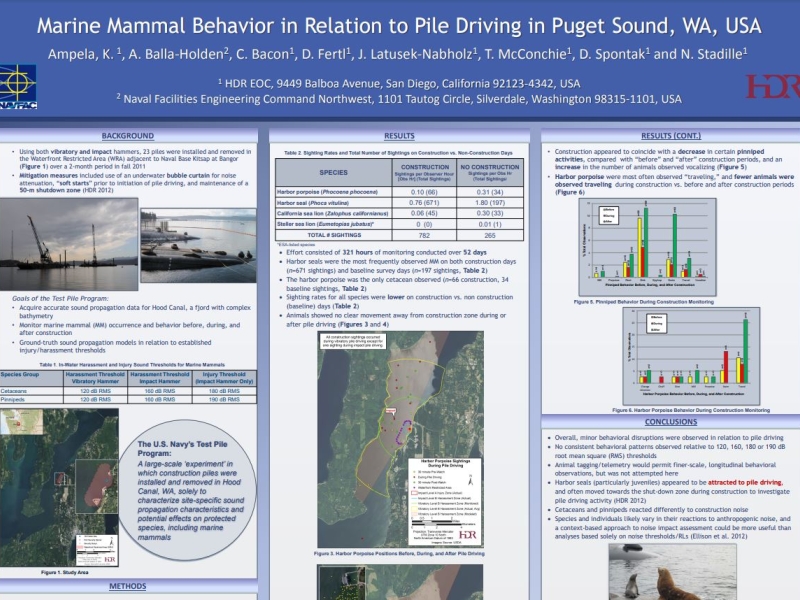
Aerial Surveys of Marine Mammals Conducted in the Inland Puget Sound Waters of Washington, summer 2013 – winter 2016
Project Objectives
1) Conduct aerial surveys during four seasonal periods within the inland Puget Sound Survey Area to assess potential differences in seasonal distribution, numbers, and behavioral state patterns of marine mammals; 2) Collect data to estimate densities of marine mammals in the inland Puget Sound waters for species with sufficient sightings; 3) Estimate abundance for each marine mammal species seen an adequate number of times; 4) Document the distribution and habitat use of each species observed; 5) Document and describe behaviors seen without performing focal follows.
Complete
Vessel-based Marine Mammal Surveys in Puget Sound, Washington
Project Objectives
Conduct marine mammal in-water vessel-based line transect surveys in the Puget Sound basin to: 1) Record data on all marine mammal species seen with the study area, with a focus on the killer whale (Orcinus orca) and the harbor porpoise (Phocoena phocoena). 2) Identify the seasonal occurrence and abundance/density of cetaceans within the study area. 3) Identify the effects of environmental variables on the distribution and abundance of species in the study area.No related blog posts to display